Ballarò Market in Palermo: hours, street food and how to visit
Ballarò Market in Palermo: opening hours, Sunday trading, the street food to try, a 90-minute self-guided walk, what food costs and which tours go there.
Ballarò is free to enter and open Monday to Saturday from 7:30 to 20:00, according to the Comune di Palermo, with a smaller market on Sunday that trades mainly in the morning. Those are market-wide hours, and many stalls shut well before 20:00 Go between about 9:30 and noon, allow 60 to 90 minutes, and eat two or three things as you walk.
If you’d like a guide to do the ordering, the Food Tour of 9+ Tastings, Arancini, Cannoli & More ($98, rated 4.8 from 41 reviews) walks through Ballarò and then the Vucciria. Book a morning departure: only those include Ballarò. Below is where the market is, what to eat, a self-guided route and what a stall lunch costs.
Check Availability
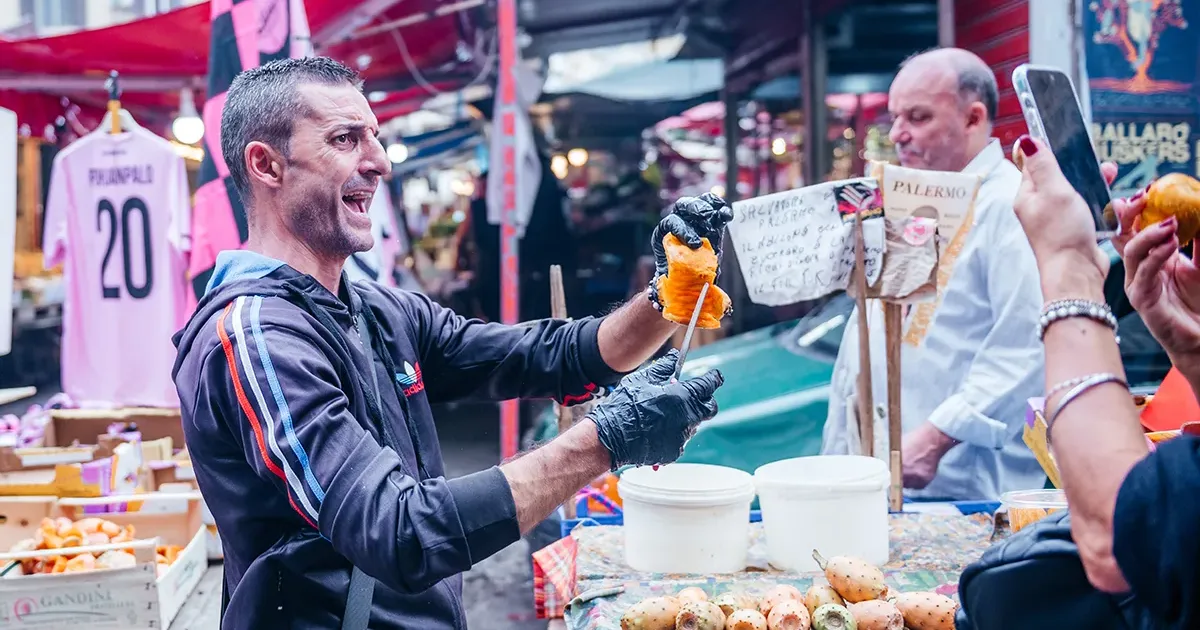
Ballarò Market at a glance
| Visitor question | Practical answer |
|---|---|
| Where is it? | Albergheria quarter, central Palermo, between Piazza Casa Professa and Corso Tukory |
| Is it free? | Yes, there is no entrance fee |
| Monday–Saturday hours | 7:30–20:00, according to the Comune di Palermo |
| Sunday hours | Mainly morning; the city gives no Sunday closing time |
| Best time to go | Around 9:30–noon, for a busy market and street-food stops |
| How long to spend | About 60–90 minutes, longer if you sit down to eat |
| Best for | Palermo street food, produce stalls, local atmosphere and photography |
| Best way to visit | On foot, on your own or with a small-group food guide |
The hours come from the Comune di Palermo’s Ballarò listing. Italy’s national tourism site, Italia.it, gives slightly different hours (7:00 to 19:30 Monday to Saturday, 7:00 to 13:00 on Sunday). That gap is a good reason not to plan around an exact closing time for any one stall.
Where is Ballarò Market in Palermo?
Ballarò runs through the lanes of Albergheria, the old quarter southwest of the Quattro Canti, between Via Maqueda and the Royal Palace. There is no building and no ticketed entrance. The stalls and food shops spread along streets and small squares.
The city describes its extent as Piazza Casa Professa to the bastions of Corso Tukory. Two easy ways in:
- From Via Maqueda and the historic centre: walk to Piazza Casa Professa and follow the shoppers into the market lanes.
- From Palermo Centrale station: walk along Corso Tukory and turn in at Via Dalmazio Birago, then carry on to Piazza Ballarò and Piazza del Carmine.
Find Ballarò Market on Google Maps.
Walk if you can. In June 2026 the city brought in an experimental pedestrian zone covering several streets and squares around Ballarò, including Via Dalmazio Birago and Piazza del Carmine, scheduled to run until December 2027. Cars can be kept out, so use walking directions and don’t count on a taxi dropping you at a stall. Read the city’s notice.
Ballarò Market opening hours: what time should you go?
The published hours and the best time to visit are two different things.
Early morning: roughly 7:30–9:30
Come now to watch Palermo buy ingredients for the day. You see the produce side of the market: fruit, vegetables, fish and meat. Not every ready-to-eat stall has its full menu going yet.
Mid-morning: roughly 9:30–noon
This is the best window for a first visit. The market is still working, the fryers are on, and you can build your walk around a few fresh snacks. Saturday mornings get crowded, so pick a weekday if you want more room to move. It sits inside the 9:00 to noon market window we suggest in our guide to the best time for a street food tour.
Afternoon and evening
The city’s listing runs to 20:00 Monday to Saturday, but many traditional stalls pack up much earlier, and shops and food counters keep their own hours. Don’t arrive at 18:00 expecting what you’d see at 10:00 For food in the evening, the Vucciria is livelier after dark, and the Original Evening Street Food Tour ($78, rated 4.8 from 720+ reviews) works its way through the Vucciria area with three drinks. Our night street food tour page compares the evening options.
Is Ballarò Market open on Sunday?
Yes, some stalls trade on Sunday mornings, but it isn’t a full market day. The city’s wording is prevalentemente solo mattina, mainly mornings, with no closing time. If Sunday is your only chance, go in the morning, expect fewer stalls and don’t plan around one particular vendor. Public holidays can change trading too. For timings at all three markets on a Sunday, see our Sunday guide.
What to eat at Ballarò Market: 8 Palermo specialities
You don’t need a big lunch at one counter. Pick two or three different things as you walk. What’s on offer changes by stall, day and season, and some well-known Palermo foods are easier to find just outside the market lanes.
1. Panelle: chickpea fritters
Panelle are thin fried slices of chickpea-flour batter. People eat them with lemon, often tucked into a soft sesame roll. They make a good first stop: savoury, filling and a staple of everyday Palermo street food.
Ask for pane e panelle if you want the sandwich.
2. Crocchè or cazzilli: potato croquettes
Crocchè are potato fritters, crisp outside and soft inside, and they usually come with panelle. Order the two together for an easy start on Palermo’s fried snacks. Recipes vary, so ask about egg, cheese and shared fryers if any of those matter to you.
3. Arancine: stuffed fried rice balls
In Palermo you’ll usually hear the feminine arancina (plural arancine). The fillings may be meat ragù, cheese or something else. A fresh one is filling enough to stand in for a light lunch.
4. Sfincione: Palermo’s thick pizza
Sfincione is a thick, soft bread topped with tomato, onion, breadcrumbs and usually anchovies. It’s nothing like a thin Neapolitan pizza. Buy a slice when you see a fresh tray, and remember that the traditional version isn’t vegetarian because of the anchovies.
5. Pani câ meusa: spleen sandwich
Pani câ meusa is a bun filled with cooked veal spleen, sometimes with other offal. It’s rich and very traditional, and you can ask for cheese on top. Try it if you like offal; skip it if you don’t, as there’s plenty else to eat.
6. Quarume: simmered offal
Quarume (also written quarumi) is slow-cooked calf offal, another old Palermo dish. Fewer visitors know it than panelle or arancine, and not every stall has it. Ask what’s in the pot before you order.
7. Boiled octopus and seasonal seafood
Some vendors sell boiled octopus or other simple seafood. It’s a break from the fried snacks. If you have a seafood allergy, assume the surfaces and utensils next to it are shared.
8. Seasonal fruit: the simplest market snack
Ballarò is a working produce market, so give the fruit stalls as much time as the fryers. Depending on the season you’ll find citrus, prickly pears, grapes and other Sicilian produce. Buy whatever looks good that day.
For more on these dishes, see the Visit Sicily street-food guide and our own list of what to eat on a Palermo street food tour.
A self-guided 90-minute Ballarò Market walk
This is a suggested route, not a marked trail, and we can’t promise which stalls will be open. It starts from the city-centre side and ends near Corso Tukory; reverse it if you arrive from Palermo Centrale.
0–15 minutes, Piazza Casa Professa. Start by the church of the Gesù (Casa Professa), get your bearings and follow the shoppers towards the market streets. The baroque church and the trading lanes next to it are two sides of the same city.
15–35 minutes, the produce market. Walk slowly past fruit, vegetable, fish and grocery stalls. Listen for the vendors’ sung sales calls, the abbanniate. People are shopping and carrying deliveries here, so leave them room.
35–60 minutes, Piazza Ballarò and the central lanes. Find a freshly made snack. Panelle with crocchè are the easy start; arancine or a spleen sandwich are heavier. You may have to check a few stalls before you find what you want.
60–75 minutes, Piazza del Carmine. Keep going through the market and stop again if something catches your eye. Decide here whether to loop back through the lanes or carry on towards Corso Tukory.
75–90 minutes, finish near Corso Tukory. Pick up some fruit or a drink, then head for your next stop. To get back to the monumental centre, retrace your steps towards Piazza Casa Professa.
If food matters more to you than sightseeing, add time for queues, cooking and asking stallholders about ingredients.
What does food cost at Ballarò Market?
Entry is free; you pay only for what you eat or buy. There’s no official price list, and portions, ingredients and prices vary from stall to stall.
For a casual tasting walk, about €15–€25 per person covers several small snacks and a drink. Treat it as a planning figure; stall prices vary. One or two items cost less; seafood, bigger portions or a sit-down meal cost more.
Carry small euro notes and coins. Not every counter takes cards, so check the price or ask before you order, especially where there’s no printed menu.
Useful phrases:
- Quanto costa? How much is it?
- Uno, per favore. One, please.
- Senza carne, per favore. Without meat, please.
- Ci sono acciughe? Are there anchovies in it?
- Grazie! Thank you!
Ballarò vs Capo vs Vucciria: which market is best?
Palermo’s historic markets aren’t interchangeable, especially at different times of day.
| Market | Best reason to visit | Best general timing |
|---|---|---|
| Ballarò | A busy working produce market with classic street-food stops | Morning, especially mid-morning |
| Capo | Another historic food market with produce and fish stalls, a short walk from Teatro Massimo | Morning |
| Vucciria | Old market streets that are now busier for food and drink in the evening | Evening for nightlife; daytime trade varies |
Choose Ballarò if you have time for only one daytime market and want neighbourhood shopping, food and atmosphere in one place. With a full morning you can do Ballarò and the Capo market too, as long as you give each one time. Our Palermo street food markets guide compares all four, Borgo Vecchio included.
Not every Palermo food tour visits Ballarò. Many daytime tours use Capo, and others stick to the Vucciria or food shops in the old centre, so check the itinerary on the listing. The market tour page shows which tours go to which market.
Should you visit Ballarò alone or book a food tour?
Go on your own if you like exploring markets, know which dishes you want and would rather pay the stalls directly. You need neither a guide nor a ticket, and our self-guided walking route ends here.
A guided food walk helps if you’re short on time, want Palermo’s food history explained or feel more comfortable with someone who speaks Italian or Sicilian doing the ordering. A guide can also tell you what’s in each dish. If you have a serious allergy, talk to the operator before you book.
Two tours on GetYourGuide walk through Ballarò:
- Our pick: the Food Tour of 9+ Tastings, Arancini, Cannoli & More, from $98, 4.8 from 41 reviews. Three hours from Porta Nuova, with arancina, sfincione, panelle, pasta alla Norma, a cannolo and wine, through Ballarò and then the Vucciria. Ballarò is on morning departures only. See our breakdown.
- The Street Food Tour in Ballarò and Vucciria Markets, from $91, 5.0 from 17 reviews. It always runs in the morning, 10:30 to 13:30, with five tastings and two drinks across Ballarò and the Vucciria. Seventeen reviews is a small sample, so weigh the perfect score accordingly. See our breakdown.
Pick the first if you want more food and a longer menu; pick the second if you want to be sure of Ballarò on any date and save $7.
Before you book any tour, check:
- Does it name Ballarò? Many Palermo street-food walks visit other markets.
- Are food and drinks included? A “food tour” doesn’t always cover every tasting.
- What time does it start? Morning departures suit a produce market best.
- How far do you walk? Ask about distance, standing time, steps and toilet breaks if they matter to you.
- What happens with dietary restrictions? Confirm the options in advance; don’t assume a substitute will be there.
Our guide to choosing a Palermo street food tour compares the other tours by price, length and reviews.
Practical tips before you visit
Wear shoes with grip. The lanes are uneven and crowded, and the ground can be wet around the produce and fish stalls. Closed shoes beat sandals.
Watch your belongings. Keep valuables zipped away and your phone in your hand only when you’re using it, as in any crowded market. The shouting is the normal sound of the market, not a sign of trouble.
Ask before you photograph someone up close. A wide shot of the market is one thing; a camera in a vendor’s face is another. A gesture or Posso fare una foto? (May I take a photo?) is polite.
Check ingredients; don’t guess. Panelle are chickpea-based, but the bread contains gluten and fryers are often shared. Sfincione can contain anchovies, and arancine can contain meat or dairy. Gluten-free and vegan travellers should ask directly about ingredients and cross-contact.
Be considerate at busy stalls. Step aside to eat so you don’t block a narrow lane, and don’t handle produce unless the seller says it’s fine.
Plan for limited accessibility. Crowds, packed stalls and uneven streets make parts of the route hard for wheelchair users and anyone who struggles to stand for long. A shorter visit on a quieter weekday helps; check the route on the day before you commit to a group tour.
Come for the market, not only the food. Even if you skip the fried snacks, the seasonal produce and the street life make Ballarò a good walk.
A little history: why is Ballarò famous?
Palermo’s tourism office calls Ballarò the city’s oldest and largest historic market. Its origins go back to the period of Arab rule in Sicily, and its narrow lanes and packed stalls still follow the Mediterranean trading habits that shaped Palermo.
Nobody is sure where the name comes from. The city lists several theories, including a link to Bahlara, a village near Monreale, and other possible roots. It’s more honest to leave it open than to pass one legend off as fact.
Another word to know is abbanniata, the loud, sing-song call merchants use to advertise their goods. It’s why Ballarò sounds so different from a quiet indoor food hall. Above all, Ballarò still serves the people who live around it, not only visitors looking for lunch.
Frequently asked questions
Is Ballarò Market worth visiting?
Yes, if you want to see a working Palermo food market. It’s free, central and easy to combine with the historic centre. Go in the morning, when most stalls are trading.
What are Ballarò Market’s opening hours?
Palermo’s city tourism portal gives 7:30 to 20:00 Monday to Saturday, and says Sunday trading is mainly in the morning. National tourism listings differ slightly, and not every stall keeps market-wide hours. Arrive well before lunch if food and produce are your priority.
Is Ballarò Market open on Sundays?
Partly, usually in the morning. Expect fewer vendors and a shorter visit than on a weekday or Saturday. The city gives no closing time for individual stalls.
Is Ballarò Market open at night?
The streets stay open and some businesses trade later, but treat Ballarò as a daytime market. For bars, late food and an evening crowd, head to the Vucciria.
Do I need a ticket for Ballarò Market?
No. Entry is free. You pay for the food, drinks or produce you buy, and a guided tour is optional.
Is Ballarò Market safe for tourists?
Plenty of travellers walk the market on their own during the day. Take the usual precautions for a crowded city, keep your belongings secure and look out for traffic on the bigger streets around it. For a calmer visit, choose a weekday morning over a busy Saturday.
How much time should I spend at Ballarò Market?
Allow 60 to 90 minutes for a first visit with snacks and photos. A quick look takes less; a slow lunch or a guided tour takes longer.
What food should I try first?
Start with panelle and crocchè, the classic Palermo pair. Then pick arancine, sfincione or pani câ meusa to suit your taste and diet. What’s available changes, so stay flexible.
Can vegetarians eat at Ballarò Market?
Yes, with questions. Panelle are made from chickpeas, and there’s plenty of fresh produce. Don’t assume a fried snack or bread is vegetarian or vegan, or that the equipment is free from cross-contact. Traditional sfincione often contains anchovies, and crocchè or arancine can include egg, cheese or meat. Read our vegetarian street food guide before you go.
Is Ballarò close to Palermo Centrale?
Yes. It’s in the central Albergheria quarter, and you can walk from the station along Corso Tukory and Via Dalmazio Birago. How long it takes depends on where you start and which part of the market you’re heading for.
Ballarò works best as a market first and a street-food stop second. Come in the morning, enter from Piazza Casa Professa or Corso Tukory, eat a couple of snacks and let the neighbourhood set the pace. You don’t need a ticket or a guide. If you want the food and history explained as you go, check dates for the morning food tour through Ballarò, or read our guides to Capo market and all four Palermo markets.
Sources and fact-checking
- Comune di Palermo, Ballarò historic market: location, hours, Sunday wording and free entry.
- Italia.it, Mercato di Ballarò: national tourism listing with slightly different hours.
- Comune di Palermo, June 2026 pedestrian-zone notice: pedestrian restrictions scheduled through 2027.
- Visit Sicily, Palermo street food: traditional snacks and dishes.
Practical details checked on 3 November 2026. Market hours, stalls, prices and tour routes can change.
Eat Your Way Through Palermo's Markets
Arancine, panelle, sfincione and pani ca meusa across the Capo and Vucciria markets with a local guide, finishing with a seasonal dessert.
Check Availability & Book