Capo Market in Palermo: what to eat, opening hours and how to visit
Capo Market in Palermo: when it's open, what to eat, how to find Porta Carini, a self-guided walk, what food costs, and the tours and cooking classes that go there.
Capo Market is free to enter, and the Comune di Palermo lists it as open every day, morning and afternoon, without exact times. Go in the morning, ideally between about 9:00 and 11:30, when the produce and fish stalls are trading and the fryers are on. Individual vendors can close early or take a day off, especially on Sundays and public holidays. With an hour, stick to Porta Carini, Via Porta Carini and the lanes next to it; with more time, add the Church of the Immaculate Conception.
If you’d like a guide, the Street Food and History Walking Tour ($56, rated 4.8 from 1,740+ reviews) spends about an hour at Capo, then visits the Cathedral and the Quattro Canti, with five tastings and a cannolo. Below is how to find the market, what to eat there, a self-guided walk and what a stall lunch costs.
Check Availability
Capo Market at a glance
| Question | Answer |
|---|---|
| Official name | Mercato del Capo, also called Il Capo |
| Location | Historic Capo / Seralcadio quarter, central Palermo |
| Main entrance | Porta Carini, close to the Palazzo di Giustizia |
| Market streets | Via Porta Carini, Via Cappuccinelle, Via Beati Paoli and Via Sant’Agostino |
| Admission | Free |
| Official opening guidance | Every day, morning and afternoon; the city gives no exact hours |
| Best time for food and atmosphere | About 9:00–11:30 |
| Time to allow | 45–90 minutes, depending on how much you eat |
| Signature foods | Panelle, crocchè, sfincione, pani câ meusa and other Palermo specialities |
| Nearest major landmark | Teatro Massimo, about five minutes’ walk away |
The market details come from the Comune di Palermo’s Capo listing. The Teatro Massimo website puts Capo about five minutes away on foot.
Where is Capo Market in Palermo?
Capo sits in the old Seralcadio quarter, northwest of the Quattro Canti and a short walk from Teatro Massimo. It isn’t one enclosed market. The stalls run along several connected lanes.
The city’s tourism portal names Via Carini, Via Beati Paoli, Via Sant’Agostino and Via Cappuccinelle as the main market streets. On a first visit, head for Porta Carini, an old city gate and one of the main ways in.
Open Capo Market in Google Maps.
How to get there from Teatro Massimo
This is the easiest approach if you’re staying in the historic centre:
- Start in Piazza Giuseppe Verdi, right outside Teatro Massimo.
- Walk towards Porta Carini, using walking directions on your phone to find the gate.
- Go through the gate onto Via Porta Carini, where the market begins.
- Keep going into the lanes; the first row of stalls is only the start.
Teatro Massimo’s visitor information puts the market about five minutes away on foot. Your walk depends on which street or stall you’re aiming for.
How to get there from Palermo Cathedral
The Cathedral and Capo are both in the central historic area. Use walking directions to Porta Carini or Via Porta Carini; there’s no point driving. They make a good morning pair: the market while the produce traders are busy, then more sightseeing.
From Palermo Centrale station or the cruise port
You can walk or take public transport from either, but Capo isn’t next to the station or the port. If you arrive by train or ship, check a live walking route and allow time to get into the old town. Don’t plan a tight market visit around a ship’s docking time: you need a buffer for getting off, getting there and walking back. Our Palermo cruise port food walk has routes via Teatro Massimo and a return-time plan.
Can you drive to Capo Market?
Walking is simpler. The lanes are narrow, and the City of Palermo announced the pedestrianisation of Via Porta Carini and Via Sant’Agostino in May 2025. Access rules can change, so don’t count on a taxi dropping you next to a stall.
Start from a central landmark and walk in.
Capo Market opening hours: when is it open?
The market’s published opening hours and the hours of a single fishmonger, fryer or grocer are not the same thing.
The Comune di Palermo listing says “Aperto tutti i giorni la mattina e il pomeriggio”: open every day in the morning and afternoon. It gives no clock times and doesn’t promise that every trader is there the whole time.
A local Capo market project publishes 6:00 to 20:00 daily, and other visitor sites give other ranges. Don’t read those as a promise of a full produce market late in the day.
Early morning: about 7:00–9:00
Come early for fresh ingredients, deliveries and the working rhythm of the neighbourhood. Produce and fish vendors are setting up or already selling. Hot street-food counters start at different times, so not every snack is ready first thing.
Mid-morning: about 9:00–11:30
This is the time we recommend for a first visit. Trading is in full swing, but there’s room to explore the lanes, compare stalls and buy a couple of snacks. If you want photos, allow extra time and stay out of the way of customers. It falls inside the 9:00 to noon market window in our best time for a street food tour guide.
Lunchtime and afternoon
Some food counters and shops keep trading after the morning rush, but the mix of open stalls changes. An afternoon visit can still be pleasant; you just won’t get the same choice of produce, fish and market activity.
If you’re coming for the market itself, not a particular restaurant or shop, choose the morning.
Is Capo Market open on Sunday?
The city’s “every day” includes Sunday, but Sunday trade is lighter and less predictable than on a weekday morning. Individual fishmongers, food counters and produce stalls may stay shut. Some tours and market-to-kitchen classes change their route on Sundays as well.
If Sunday is your only day, go in the morning, enjoy what’s open and don’t build lunch around one named stall. On a guided tour, ask whether the market is part of your date.
What about Mondays, winter and public holidays?
Expect it to vary by vendor. Some businesses take a weekly day off, and holiday trading differs. Palermo’s mild winters make a market walk possible all year, though heavy rain can thin out the outdoor stalls. No single timetable covers every trader through the year.
What to eat at Capo Market: 9 Palermo food specialities
Capo is known for everyday Palermo street food. The city’s tourism office names sfincione, sfincionello, spleen sandwiches, panelle and potato croquettes among the foods its vendors sell.
What’s on offer changes by day and stall. Use the list below as a tasting checklist; no vendor stocks all of it.
1. Panelle: Palermo’s chickpea fritters
Panelle are thin chickpea-flour fritters, fried golden and served hot. You can eat them on their own, but the classic order is pane e panelle: fritters in a soft roll, often with a squeeze of lemon.
They’re a good first bite if you want something that belongs to Palermo itself.
What to ask for: Pane e panelle, per favore.
2. Crocchè (cazzilli): potato croquettes
Crocchè, often called cazzilli in Palermo, are potato croquettes, soft inside with a crisp fried crust. They usually sit next to the panelle, and ordering both gets you two classic market flavours in one stop.
Recipes differ. Ask about egg, cheese and shared frying oil if you’re vegetarian, vegan or have allergies.
3. Sfincione and sfincionello: Palermo’s thick savoury bread
Sfincione is Palermo’s thick, soft, pizza-like bread, usually topped with onion, tomato, breadcrumbs and often anchovies or cheese. A smaller single portion may be called sfincionello.
It’s one of the foods the city names in its market description. Look for a freshly cut piece; not every tray has just come out of the oven.
Traditional sfincione often includes anchovies, so it isn’t automatically vegetarian.
4. Pani câ meusa: the spleen sandwich
Pani câ meusa (also written pane con la milza) is one of Palermo’s best-known traditional sandwiches: a bun filled with cooked veal spleen, sometimes with other offal, and cheese on top if you want it.
It’s rich and salty and nothing like standard tourist food. Try it if you like offal; if you don’t, there’s plenty else to eat.
What to ask: Con formaggio? With cheese?
5. Arancine: fried stuffed rice
A Palermo arancina (plural arancine) is a rice ball, breaded and fried to a golden crust. Fillings include meat ragù, cheese or vegetables. One is filling, so share if you want to try several things on the same walk.
Arancine are found all over Palermo, not only at Capo. Buy one wherever you see a fresh batch, in the market streets or a shop nearby.
6. Caponata: sweet-and-sour Sicilian vegetables
Caponata is usually aubergine, tomato, celery and olives in a sweet-and-sour dressing. It’s a prepared dish, not something from the fryer.
You may find it at a prepared-food counter or a casual lunch spot around the market, but don’t expect every street-food stall to have it. Recipes vary, so ask before you order if you have dietary restrictions.
7. Fresh seafood or simple cooked fish
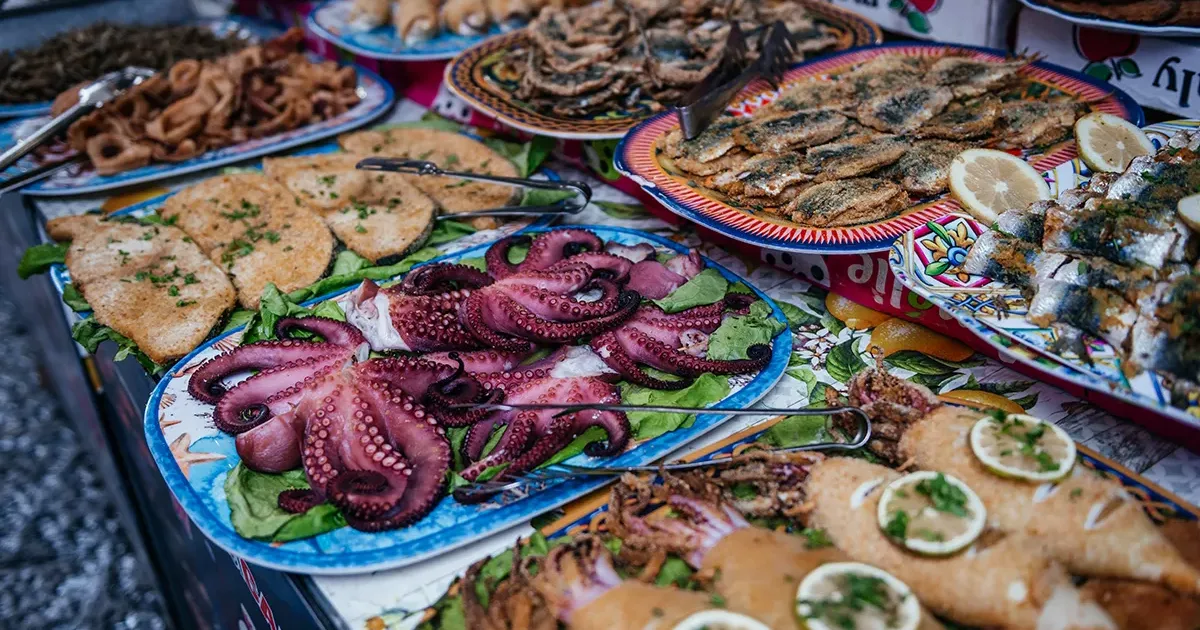
Fish stalls are central to Capo, but a fish market isn’t a seafood restaurant. Many traders sell raw fish to people cooking at home. Some counters and eateries nearby sell ready-to-eat seafood; check what’s on offer and whether it’s cooked to order.
If you’re allergic to fish or shellfish, take care around shared surfaces and utensils.
8. Seasonal fruit, olives and local produce
You don’t have to eat fried food at every stop. The fruit and vegetable stalls are a big part of why locals still shop here. Depending on the season you’ll see citrus, grapes, tomatoes, aubergine, prickly pears and other Sicilian produce.
For a simple snack, buy whatever fruit looks best that day.
9. Cannoli or another Sicilian sweet nearby
Cannoli, crisp pastry tubes filled with sweetened ricotta, are a good way to finish a food walk. You’ll find them more easily at a bakery or pastry shop near the market than at a produce stall.
A cannolo filled just before serving keeps its shell crisp. If no market counter has one, walk on into the historic centre for it.
For more on traditional dishes, see Visit Sicily’s Palermo street-food guide and our list of what to eat on a Palermo street food tour.
Self-guided Capo Market walking route: 60–90 minutes
This route is for first-time visitors who want to go at their own pace. It’s a suggested path through connected lanes, not a marked one-way route. Check your map as you go and double back if you spot a good stall.
Stop 1: Teatro Massimo and the approach (0–10 minutes)
Start outside Teatro Massimo in Piazza Verdi, one of the easiest landmarks to find in central Palermo. From here, walk to Porta Carini by the short route your map gives you.
Within a few minutes the opera house and its wide square give way to cramped market streets.
Stop 2: Porta Carini (10–20 minutes)
Porta Carini is one of Capo’s main entrances and a good place to get your bearings. According to the city, the present gate dates from the 18th century and was rebuilt on a 15th-century original. Take a photo, then follow the traders onto Via Porta Carini.
Find Porta Carini on Google Maps.
Stop 3: Via Porta Carini, your first tasting (20–40 minutes)
Walk past fruit, vegetable, grocery and meat sellers. Listen for the vendors’ loud, rhythmic sales calls, the abbanniate, and look at how the produce is stacked in front of the small shops.
Choose one savoury snack here. Panelle or crocchè are a good start; sfincione is another if you see it. Don’t buy three big portions straight away if you want room for more.
Stop 4: Church of the Immaculate Conception (40–55 minutes)
At Via Porta Carini 38, the Chiesa dell’Immacolata Concezione al Capo has a plain front and a richly decorated Baroque interior of coloured marble and gilding.
It’s one of the best short cultural stops in the area. Published opening hours and entry details differ between listings, so check the city’s church page or ask at the church before you count on the door being open or on a ticket price. If it’s shut, carry on with the market.
Stop 5: The connecting market lanes (55–75 minutes)
Follow the market’s branches around Via Cappuccinelle, Via Beati Paoli and Via Sant’Agostino, taking whichever turn suits your next stop. The streets don’t run in one straight line, and that’s part of the fun.
Stop for a second snack or browse the produce. To finish nearer the main streets of the historic centre, head for the Via Sant’Agostino side.
Stop 6: Finish with coffee or a Sicilian sweet (75–90 minutes)
End at a café or pastry shop nearby, or walk on to another landmark. By now you’ve seen the working market and some of the history around it.
Short on time? Skip the church and the longer loop. Start at Porta Carini, walk the lanes for 30 to 45 minutes and eat one freshly made snack.
How much does it cost to eat at Capo Market?
Entry costs nothing. What you spend depends on whether you buy one sandwich, several tastings, picnic ingredients or a full meal nearby.
There’s no official price list, and prices change with the business, the portion and the ingredients. Set aside about €15–€25 per person for a few casual snacks and a drink. Treat it as a planning figure; stall prices vary. One item costs less; seafood, a sit-down lunch or a guided tour costs more.
Carry small euro notes and coins. Some sellers take cards, but not every small counter does. Check the price or ask before you order.
A few useful phrases:
- Quanto costa? How much is it?
- Uno, per favore. One, please.
- È preparato al momento? Is it made fresh?
- Ci sono acciughe? Are there anchovies in it?
- Sono vegetariana / vegetariano. I’m vegetarian.
- Posso pagare con carta? Can I pay by card?
Capo vs Ballarò vs Vucciria: which Palermo market should you visit?
All three are good, and each suits a different visit.
| Market | Main appeal | Best general visiting window | Who should choose it? |
|---|---|---|---|
| Capo | A compact web of food stalls near Teatro Massimo, with classic Palermo snacks | Morning | Visitors who want food on an easy central walking route |
| Ballarò | Palermo’s biggest working market, with produce, local shopping and street food | Morning | Visitors who want the largest daytime market |
| Vucciria | Old market streets with a busier food-and-drink scene at night | Daytime market or evening bars, depending on what you want | Visitors most interested in the evening |
Choose Capo if you’re already going to Teatro Massimo or want a market and a snack that fit into a historic-centre morning. Choose Ballarò for a bigger market and a longer wander. Which is better depends on your route and the time of day.
With half a day, you can visit both Capo and Ballarò and stop for a snack at each. Don’t try to tick off every market in 30 minutes.
For the full comparison, see our guide to Palermo’s street food markets and our Ballarò Market guide.
Should you visit Capo on your own or book a street-food tour?
You don’t need a tour. The market is public, entry is free and the streets are easy to explore if you’re comfortable in a busy city market.
A guided street-food tour helps when you want ingredients explained, the history behind the dishes and the differences between neighbourhoods. On a short stay, a guide also saves you time deciding what to eat.
Not every Palermo street-food tour goes to Capo, though. Some use Ballarò or the Vucciria, and some meet near Teatro Massimo without walking through the market.
Three tours on GetYourGuide walk through Capo:
- Our pick: the Street Food and History Walking Tour, from $56, 4.8 from 1,740+ reviews, the most-reviewed tour on this site. Three hours, about one of them at Capo, then the Cathedral, the Quattro Canti and the Pretoria fountain, with five tastings, a cannolo and one drink. Cruise passengers can ask for a 10:00 pickup in the port. See our breakdown.
- Streaty’s Original Street Food & Market Tour, from $78, 4.9 from 610+ reviews. Three hours through Capo and the Vucciria with a full round of street food and three drinks, and no fish or seafood on the route. See our breakdown.
- The Street Food Walking Tour with Local Guide & Tasting, from $50, 4.8 from 1,130+ reviews. Book the morning option: only that one visits Capo. Drinks aren’t included. See our breakdown.
Take the $56 tour if you want Capo plus the main sights; pay $22 more for Streaty if you’d rather eat a full meal with drinks and spend the whole walk on food.
Before you book, check:
- Does the itinerary name Capo or Mercato del Capo? A meeting point near Teatro Massimo doesn’t prove a market visit.
- What time does it run? Morning departures suit the market best.
- Which tastings are included? Find out whether food, drinks and extras are in the price.
- Is it mostly walking or mostly sitting? Check distance, steps, standing time and access.
- Can it handle your diet? Contact the operator in advance about serious allergies or restrictions.
- Does the route change on Sundays, holidays or rainy days? Confirm the market is part of your departure.
Our market tour page and our guide to choosing a Palermo street food tour compare the rest.
Capo Market cooking classes: is a market-to-kitchen class worth it?
If you’d rather cook than only taste, a Palermo cooking class with a market visit may suit you better. Some take you through Capo to look at ingredients or shop before you head to a kitchen for a hands-on lesson.
Recipes can include fresh pasta, arancine or cannoli, depending on the class and the season. More dishes doesn’t mean a better class: look for real hands-on time, a clear group size and a meal at the end.
Two classes on GetYourGuide start at Capo:
- Our pick: Palermo Pasta & Gelato or Sicilian Cooking & Market, from $69, 4.9 from 360+ reviews. Choose the Sicilian Cooking & Market option: you walk Mercato del Capo with a chef, then cook and eat a three-course meal. If the market is closed, the visit is replaced by an introduction and extra tastings at the school. See our breakdown.
- The Sicilian Cooking Class with Market Tour & Meal, from $136, 5.0 from 42 reviews. Four hours in a home near Mercato del Capo, with handmade pasta, a market tasting and a shared lunch. Two dogs live in the house. See our breakdown.
The $69 class is the better value; the $136 one suits you if a small class in a family home matters more than the price. Our cooking class and market tour page covers the rest.
Before you pay, check:
- that the class names the market;
- whether the visit includes buying ingredients or is a short introduction;
- whether the market visit is dropped on Sundays or other dates;
- whether the stated length covers the walk, the cooking and the meal;
- whether the recipes and kitchen can handle your diet.
Some classes swap in extra tastings when the market isn’t available. That can still be fun, but it isn’t a visit to a working market. Read the details; the words “market tour” in a title aren’t enough.
Is Capo Market safe? Practical tips for visiting
Capo is a busy city market, and ordinary city common sense serves you better than scare stories about the neighbourhood.
Keep valuables secure. In crowded lanes, keep your bag close and your phone away when you’re not using it. People stop suddenly to shop or carry crates.
Wear practical shoes. The ground can be uneven or wet around the stalls, and some streets are crowded. Shoes with grip beat sandals.
Don’t block the stalls. Step aside to eat, check your map or take photos. Ask before photographing a vendor or shopper up close: Posso fare una foto?
Check allergens directly. Traditional snacks can contain gluten, dairy, egg, anchovies, meat or offal, and fryers and work surfaces are often shared. Nothing at the market is guaranteed allergen-free, and a guided tour isn’t automatically allergy-safe.
Be considerate of residents. People are doing their food shopping and vendors are working, so let them through the narrow lanes.
Plan for accessibility. The streets are uneven, the passages tight and the crowds variable. With a wheelchair, mobility aid or pushchair, try an off-peak weekday and look at the route before you book a group tour.
Use a toilet before you go in. The market has no public toilets in the lanes. Cafés nearby may let customers use theirs, sometimes only with a purchase.
Check the forecast. You can visit year-round, but wind and rain can close stalls and make the walk less pleasant.
A short history of Mercato del Capo
Capo lies in Palermo’s Seralcadio quarter, whose history goes back to the city’s Islamic period. Like Palermo’s other historic markets, it carries centuries of Mediterranean trade and Sicily’s layered past.
The Comune di Palermo describes Capo’s streets as keeping the tight, winding layout of an old souk. The city also notes the area’s history of meat trading and butchers’ shops, which still sit alongside the food sellers.
Porta Carini, the gate most visitors use, was rebuilt in the 18th century on the site of a 15th-century gate. Inside the market, churches and old buildings stand next to small shops, and daily life and history share the same street.
You’ll hear the abbanniate, the calls vendors use to sell their goods. They belong to the working market, which is one more reason to come in the morning.
Frequently asked questions
What is Capo Market famous for?
Its traditional food market and Palermo street food, including panelle, crocchè, sfincione and spleen sandwiches. It’s also known for its narrow lanes, loud vendors and its spot near Teatro Massimo.
Is Capo Market free to enter?
Yes. The city lists free entry. You pay only for food, groceries, other shopping or an optional guided tour.
What time does Capo Market open and close?
The city’s tourism page says it’s open every day in the morning and afternoon, with no clock times. Other sources give more exact hours that don’t apply to every seller. Aim for 9:00 to 11:30 to see the market at its busiest.
Is Capo Market open on Sundays?
The city’s listing includes Sunday, but some traders close or open for less time. Sunday morning is the best bet; confirm any particular stall or guided tour in advance.
Is Capo Market open on Mondays?
The city says every day, which includes Monday. Individual fishmongers, food businesses and speciality shops can still take a day off, so the selection varies through the week.
Is Capo Market open at night?
Some businesses in the area stay open later, but plan Capo as a daytime market. The published hours don’t mean produce and fish stalls are trading in the evening.
Is Capo Market better than Ballarò?
Neither is better across the board. Capo is handy for a market stop near Teatro Massimo, while Ballarò is bigger and better for a long daytime wander. If you have time, do both.
How far is Capo Market from Teatro Massimo?
Teatro Massimo’s visitor information gives about a five-minute walk. It depends on which street or entrance you head for.
How much time do you need at Capo Market?
Allow 45 to 90 minutes for a first visit with a couple of food stops. You can walk through in 30 minutes, but you’ll see less.
What should I eat first at Capo Market?
Start with panelle and crocchè, then sfincione or an arancina. If you like offal and want something very Palermo, try pani câ meusa. What you find depends on which stalls are open.
Can vegetarians or vegans eat at Capo Market?
There are things to ask about, especially panelle and fresh produce. Check recipes, bread ingredients and shared frying oil. Sfincione often contains anchovies, and crocchè, arancine and other dishes may include dairy or egg. Our guide to vegetarian and vegan street food in Palermo lists what to check.
Are there guided tours of Capo Market?
Yes. Several Palermo street-food tours and cooking classes include Capo; the Street Food and History Walking Tour spends about an hour there. Always check the itinerary: a general Palermo street-food tour may visit another market, and some cooking classes change the route on Sundays.
Can you combine Capo Market with Palermo Cathedral?
Yes. Both are in the central historic area, so a market walk and a Cathedral visit fit into one morning. Check church hours and tickets if you plan to go inside.
Is Capo Market suitable for children?
Children usually enjoy the colours, food and noise, but narrow lanes and crowds are awkward with a pushchair. Keep small children close, watch for delivery traffic on the streets around the market and pick simpler snacks if they’re new to local food.
Capo is worth a morning, especially if food is a priority on your Palermo trip. Start at Porta Carini, come before lunch, try two or three Palermo specialities and walk past the first row of stalls. A self-guided walk is enough for many visitors, and our self-guided Palermo walking tour starts here. If you want the food explained or a hands-on class, pick one that names Mercato del Capo: check dates for the street food and history tour through Capo, or read our Ballarò Market guide for the other morning market.
Sources and fact-checking
- Comune di Palermo, Capo historic market: market streets, Porta Carini, history, typical foods, free entry and opening guidance.
- CapoMercato, local market project: a separately published daily schedule, not a promise of individual stall hours.
- Fondazione Teatro Massimo, getting here: location and the approximate walk to Capo.
- Comune di Palermo, pedestrianisation of Via Porta Carini and Via Sant’Agostino: city announcement dated 16 May 2025.
- Comune di Palermo, Chiesa dell’Immacolata Concezione al Capo: address, history and visitor information (the city warns that hours and prices may be out of date).
- FAI, Il Mercato del Capo: cultural and historical background on Capo’s streets and gate.
- Visit Sicily, Palermo street food: regional food background.
Visitor information reviewed on 3 November 2026. Stall hours, tour routes, prices and church entry can change.
Eat Your Way Through Palermo's Markets
Arancine, panelle, sfincione and pani ca meusa across the Capo and Vucciria markets with a local guide, finishing with a seasonal dessert.
Check Availability & Book