Palermo self-guided walking tour: historic sights and a street food route
A free self-guided Palermo walk from Capo Market to Ballarò via Teatro Massimo, the Cathedral, Quattro Canti and Piazza Bellini, with food stops, timings and tips.
Start at Porta Carini around 9:00 a.m., browse Capo Market, pass Teatro Massimo, walk to the Cathedral, follow Corso Vittorio Emanuele to the Quattro Canti, see Piazza Pretoria and Piazza Bellini, and finish with street food at Ballarò. Allow about 3 to 4 hours for a relaxed outdoor walk with several food stops, and more if you go inside the theatre or the churches. Walking the route costs nothing; you pay for food and any ticketed interiors.
If you’d rather have a guide pick the stalls and tell the stories, the Street Food and History Walking Tour ($56, rated 4.8 from 1,740+ reviews) covers much of the same ground: Porta Carini, about an hour in the Capo market, Teatro Massimo, the Cathedral, the Quattro Canti and the Pretoria fountain, with five tastings and a cannolo. Read our breakdown for the stop list. The rest of this page is the route to do on your own.
Check Availability
Palermo walking tour at a glance
| Planning question | Recommendation |
|---|---|
| Starting point | Porta Carini, the entrance to Capo Market |
| Finish | Ballarò Market, in the Albergheria district |
| Best starting time | Around 9:00 to 9:30 a.m., while the market is busy |
| Walk length | Roughly 3 to 4 hours with pauses and tastings; longer with interiors |
| Walking difficulty | Manageable for most, with uneven paving, crowded lanes and some kerbs |
| Main sights | Capo, Teatro Massimo, the Cathedral, Quattro Canti, Piazza Pretoria, Piazza Bellini, Ballarò |
| Street food stops | Capo Market first, Ballarò later; a bakery or pastry stop on the way if you like |
| Cost of the route | Free; snacks and interior tickets are extra |
| Best for | First-time visitors, food lovers, independent travellers, cruise passengers with enough time ashore |
| Sunday | Some trading is reduced; Ballarò is mainly a morning market on Sundays |
This is a route we put together, not a scheduled tour. No stall is promised to be open, there are no included tastings, and the distance depends on the lanes and detours you choose. The directions follow landmarks that don’t move. If you’d prefer a guide, compare the Palermo street food tours on the homepage, and for the markets on their own, read the Palermo street food markets guide.
The Palermo self-guided walking route, stop by stop
Enter this sequence into any map app:
Porta Carini → Capo Market → Teatro Massimo → Palermo Cathedral → Quattro Canti → Piazza Pretoria → Piazza Bellini → Ballarò Market.
Open the starting point, Porta Carini, in Google Maps.
Save the stop names in your map app before you leave your accommodation. That works better than a fixed turn-by-turn list, because the market lanes get busy and roadworks or temporary barriers can change the easiest path on foot.
Stop 1: Porta Carini and Capo Market, a savoury breakfast
Suggested time: 9:00 to 9:45 a.m.
Start at Porta Carini, the old gate at the entrance to the Mercato del Capo, in the northern part of the historic centre. The lanes around Via Carini and Via Beati Paoli hold produce sellers, butchers, fishmongers and counters frying Palermo snacks. Walk in slowly: the colours, the shouting and the everyday shopping are what you came for.
The city’s tourism portal says Capo trades every day, morning and afternoon, and a local market project, CapoMercato, publishes 6:00 a.m. to 8:00 p.m. daily. Each stall keeps its own hours and many quieten after lunch. Come in the morning if you want to see a working food market and not a row of half-closed shutters.
What to eat: look for panelle, hot chickpea-flour fritters, and crocchè (also called cazzilli), fried potato croquettes. They often come together in a bread roll. If something looks cold or has been sitting a while, pick a busy stall frying fresh portions.
Practical tip: carry small notes and coins, because not every trader takes cards. Eating standing up is normal at takeaway counters; step away from the counter once you have your food.
For the full market guide, read Capo Market Palermo: what to eat, opening hours and how to visit.
Stop 2: Teatro Massimo, Palermo’s opera house
Suggested time: 9:45 to 10:05 a.m.
Walk from Capo to Piazza Giuseppe Verdi and Teatro Massimo. After the tight market lanes you come out into a wide square in front of one of Palermo’s best-known buildings.
The theatre makes a good reference point. Its visitor information puts Capo about five minutes away on foot, the Quattro Canti about ten and the Cathedral about fifteen. Treat those as rough guides; your pace may differ.
On this walk, enjoy the façade and the steps, then move on. If the architecture appeals, the theatre runs a guided interior tour of about 40 minutes; the standard full ticket is €14 from July 2026, listed on the official guided-tours page. Check that page for later changes or closures.
Street food tip: pick up water here, and keep your appetite for Ballarò. Palermo suits several small tastings more than one big first meal.
Stop 3: Palermo Cathedral, centuries of architecture
Suggested time: 10:15 to 10:45 a.m.
From the theatre, walk to Corso Vittorio Emanuele and the Cathedral of Palermo. The outside shows Sicily’s history in layers: towers, arches, portals and later additions from different periods share one great complex.
The Cathedral is part of the UNESCO World Heritage property Arab-Norman Palermo and the Cathedral Churches of Cefalù and Monreale. The listing has nine components, among them Palermo Cathedral, the Royal Palace and Palatine Chapel, La Martorana and San Cataldo.
For a shorter walk, look at the outside and the square. If you want to go in or visit the ticketed areas, allow extra time and check the Cathedral’s current visitor rules first. Don’t assume the roof, the treasury or every interior area is included in a free visit.
Optional detour: if you have most of a day, carry on along Corso Vittorio Emanuele to Palazzo dei Normanni and the Palatine Chapel, then come back to the route. That adds a long sightseeing stop, not a quick snack, and tickets, entry times and queues can stretch your day.
Photo tip: step back to fit the whole façade in, then look for the smaller carved details.
Stop 4: Quattro Canti, the crossroads of old Palermo
Suggested time: 10:50 to 11:05 a.m.
Follow Corso Vittorio Emanuele back to where it crosses Via Maqueda. This is the Quattro Canti, formally Piazza Vigliena, where four curved, decorated façades frame the crossroads.
Stop here to get the layout of the city. Sicily’s official tourism itinerary explains that the crossroads divides the historic centre into its four traditional quarters: La Loggia, Il Capo, La Kalsa and L’Albergheria. One road leads back towards the Cathedral, the others towards the sea and the central markets.
There’s no ticket and no need for a long stop; the square is the sight. Take photos from the pavement, watch for cars and bikes, and use the crossroads to find your way for the rest of the walk.
Street food tip: treat the Quattro Canti as a sightseeing pause. Save your next proper tasting for Ballarò, where the market is the point.
Stop 5: Piazza Pretoria and the Fountain of Shame
Suggested time: 11:05 to 11:20 a.m.
A short walk along Via Maqueda brings you to Piazza Pretoria and its elaborate fountain, often nicknamed the Fontana della Vergogna, the Fountain of Shame. Palermo feels nothing like a beach resort here: the grand buildings around it are packed with civic, religious and trading history.
You can see the square without a ticket. Separate rules may apply to particular monuments and fenced areas.
Suggested pause: stop for a drink here and get your bearings before the church square next door.
Stop 6: Piazza Bellini, La Martorana and San Cataldo
Suggested time: 11:20 to 11:45 a.m.
Right next door, Piazza Bellini puts two remarkable churches side by side: Santa Maria dell’Ammiraglio, usually called La Martorana, and San Cataldo with its red domes. Both belong to the UNESCO Arab-Norman listing.
Even from outside the stop pays off, because the two buildings look nothing alike yet share overlapping influences. If you have time, go inside one; check opening hours, services and tickets first.
Walking on your own helps here: you set the balance between churches and food. Some visitors spend 45 minutes inside; others take ten minutes in the square and go to lunch. Either works.
Food option: if you want something sweet, find a pastry shop that fills cannoli to order. A shell filled just before serving stays crisp; one filled hours earlier goes soft.
Stop 7: Ballarò Market, finishing with Palermo street food
Suggested time: 11:50 a.m. to 12:45 p.m., or later
Walk from Piazza Bellini towards Piazza Casa Professa and into Ballarò Market. Here the route swaps monuments for one of Palermo’s oldest food markets. Ballarò runs through the Albergheria district towards Corso Tukory, so explore as much of it as you like.
The city tourism portal lists Ballarò’s hours as Monday to Saturday, 7:30 a.m. to 8:00 p.m., with Sunday trading mainly in the morning. Those are the market’s general hours; plenty of food stalls stop well before 8 p.m. Arriving late morning or at lunchtime, as this route does, catches most of them open.
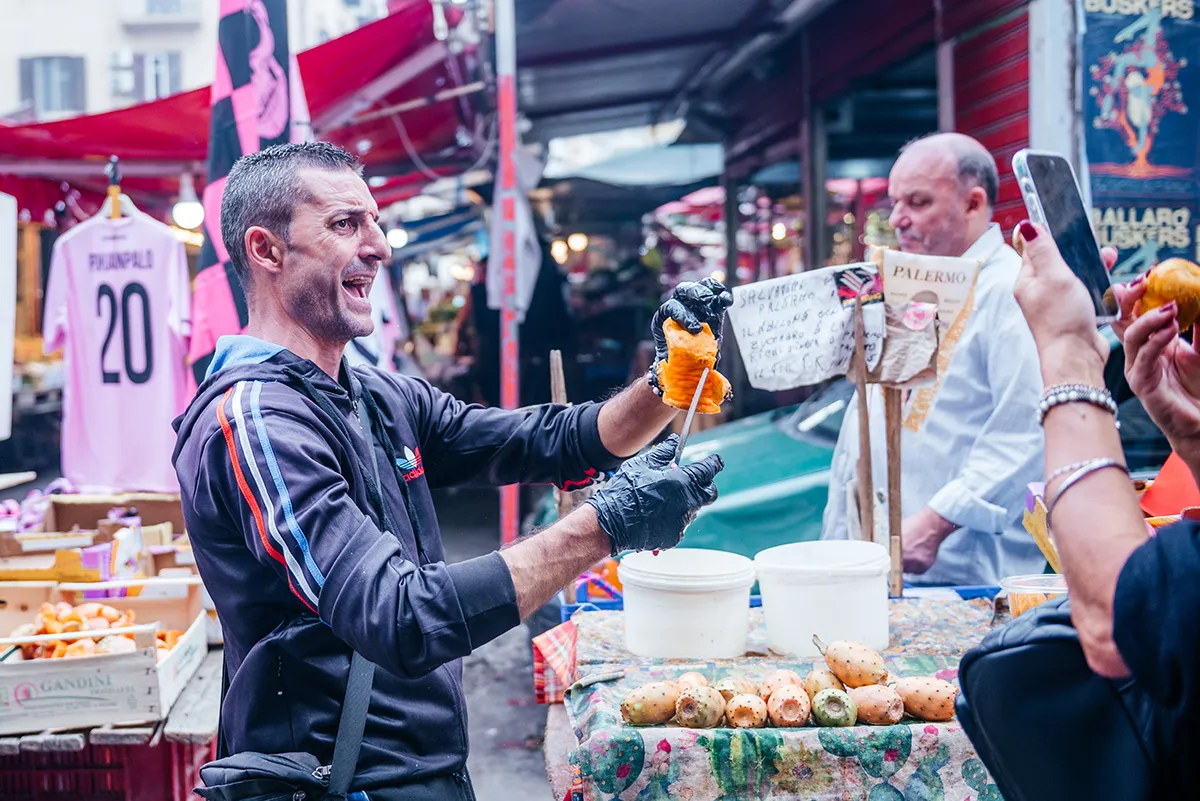
Ballarò is known for its abbanniata, the sing-song calls traders use to sell their goods, as much as for its food. Listen to the bargaining, take your time, and remember that locals do their shopping here.
What to eat: try one or two savoury things you missed at Capo. Dishes commonly found in Palermo include:
- Arancina: a breaded, fried rice ball, often filled with ragù or other savoury fillings. In Palermo the word is usually feminine, arancina.
- Sfincione: a thick, soft Sicilian bread-based dish, often topped with tomato, onion, anchovy and cheese; recipes vary.
- Pane con la milza / pani câ mèusa: a bread roll with cooked spleen and often lung. It isn’t vegetarian.
- Panelle and crocchè: the classic pair for travellers who want something without meat; ask about the oil, seasoning, fillings and cross-contact if you have dietary needs.
- Seasonal fruit: depending on the month, a good break from yet another fried snack.
A common mistake: a market visit isn’t a planned tasting tour. You can eat very well on your own, but you choose the stalls, ask about ingredients, pay at each one and decide what to try. For a guided version, compare the Palermo street food tours on our homepage.
For trading hours, Sunday visits and dishes to order, see the Ballarò Market Palermo guide.
The best food to try on this Palermo walk
Split your tastings between Capo and Ballarò. You get to compare the two markets, and you won’t be too full for the rest of the walk.
| Food | What it is | Where on the route | Dietary note |
|---|---|---|---|
| Panelle | Fried chickpea-flour fritters, often in bread | Capo | Chickpea-based; ask about shared fryers |
| Crocchè / cazzilli | Fried potato croquettes | Capo | Check added ingredients and shared frying oil |
| Arancina | Fried, filled rice ball | Ballarò or a bakery on the way | Fillings vary; many contain meat, cheese or both |
| Sfincione | Soft, thick Sicilian savoury bread | Ballarò | Traditionally may contain anchovy and cheese |
| Pani câ mèusa | Roll filled with spleen, often lung | Ballarò or another specialist counter | Offal; not vegetarian |
| Cannolo | Crisp pastry shell with sweet ricotta | A pastry stop between sights | Dairy and usually gluten; ask about nuts |
| Fresh seasonal fruit | Produce from the market stalls | Either market | Wash or peel before eating |
The official Visit Sicily street food guide covers many of these staples. What’s on sale varies by stall, time of day and season; not every counter makes every famous dish.
How much money should you budget for street food?
There’s no official price list, and stalls change prices without notice. Set aside about €15 to €25 per person for several small takeaway tastings and a drink; that’s our planning figure, not a quoted price. You may spend less, or more with bigger portions, alcohol, desserts or a sit-down meal.
Bring some cash even if you usually pay by card. Nothing on the public walking route needs booking.
Can you do this Palermo walking tour in two hours?
Yes, if you take a shorter version and skip stops; rushing through all seven defeats the purpose. The full route is for people who want to look around and eat, not spend thirty seconds at each landmark.
For a two-hour highlights walk, start at Teatro Massimo, walk to the Cathedral, come back along Corso Vittorio Emanuele to the Quattro Canti, and finish via Piazza Pretoria and Piazza Bellini at Ballarò. Skip the Capo loop and keep the Ballarò tasting short.
For a half day, follow the full seven-stop route with several food breaks.
For a full day, add the Royal Palace and Palatine Chapel, a theatre interior tour or one of the historic churches. Each has its own tickets and entry times, so don’t expect all three to fit into a short morning.
Optional extension: the Vucciria and an evening food walk
To keep going after lunch, head back towards the Quattro Canti and La Loggia and explore the lanes around Via Argenteria, Piazza Caracciolo and Piazza Garraffello, the old Vucciria area.
Pick your time carefully, though. The Vucciria isn’t a second Ballarò. Its daytime produce market has shrunk a great deal, and the area’s bars and informal food are now mostly an evening scene. If you arrive straight after lunch, enjoy the history and the lanes, and don’t expect a crowded morning market.
For many visitors the better plan is to finish the main walk at Ballarò, rest in the afternoon and come back to the Vucciria in the evening if nightlife appeals. Read the Vucciria Market guide first.
When is the best time to walk around Palermo?
Morning: best for markets and food photos
A morning start works best overall: Capo is already trading, and you reach Ballarò while many of its stalls are busy. You also get the produce, the market life and the buildings before the crowds build.
Afternoon: fine for monuments, less so for markets
An afternoon walk still works for the landmarks, but the markets are less lively. Individual stalls often close before a market’s advertised closing time.
Evening: keep it for nightlife or a guided food tour
Palermo’s lit-up streets are lovely after dark, but an evening walk is a different outing from this market route. The Vucciria suits an evening extension; visit Ballarò and Capo earlier in the day.
November to February: a good time for a city walk
Palermo stays a good walking city outside the summer peak. Expect shorter days, some rain and the occasional cold or windy day. A morning market followed by churches, museums or a long lunch makes a flexible winter plan. If you plan around sunset, check the time for your date.
If you’re adding a glass of wine to the day, our guide to wine tasting in Palermo covers city tastings, evening food-and-wine walks and wineries outside town.
Practical tips before you start
Wear comfortable shoes and watch the paving
The historic centre has cobbles, uneven stone, steps and crowded pedestrian streets. Comfortable shoes matter more than hiking gear. Take care on wet stone after rain.
Don’t drive between the stops
All the stops are within Palermo’s central walking area. The old town also has limited traffic zone (ZTL) rules that change by day and season, so driving a short route is more trouble than walking it. If you arrive by car, check parking and ZTL rules in advance so your navigation app doesn’t lead you into restricted streets.
Be respectful in the markets
Stalls are workplaces. Ask before photographing traders up close, don’t block customers, and don’t handle produce unless invited. There’s no need to haggle over small snacks; check the posted price or ask before you order.
Carry water and plan toilet breaks
There aren’t public toilets at every landmark. A café stop helps, but sitting down can cost more than takeaway, so check the menu first.
Check allergens with the seller
Ingredient lists can be incomplete and recipes vary. Food that looks vegetarian may be fried in shared oil, and seafood, nuts, wheat, milk and eggs can all turn up depending on what you order. If you have a serious allergy, ask the seller directly; a travel guide can’t tell you what’s in a particular stall’s recipe. For meat-free eating, see our guide to vegetarian food in Palermo.
Think about crowds and accessibility
This isn’t a wheelchair-accessible route. Many central streets are passable, but market lanes are narrow and busy, paving is uneven and historic interiors may have steps. The Teatro Massimo visitor page has accessibility information for its guided tour. On the street route, use the wider streets when market lanes are packed.
Self-guided Palermo walk vs guided street food tour
Both work well; they suit different travellers.
| Self-guided walking tour | Guided street food tour | |
|---|---|---|
| Route planning | You choose the pace and the stops | The operator plans the itinerary |
| Food | You choose and pay at each counter | Tastings are often included; check the listing |
| Cost | Free to walk; you pay for food and interiors | Ticket price depends on the operator and what’s included |
| Local history | Read ahead or use an audio guide | A guide explains the sights and the food |
| Dietary needs | You choose what to order | Ask before booking whether alternatives exist |
| Flexibility | Total, so you can take spur-of-the-moment detours | Fixed start and end times |
| Best for | Independent travellers with time to explore | Visitors who want context, convenience and chosen stops |
Go self-guided if you mainly want the landmarks, a few snacks, photos and your own pace. Book a food tour if you’d like help with unfamiliar dishes, a set of tastings chosen for you, and the markets explained in English or another language.
Our pick on GetYourGuide for a guided version of this walk: the Street Food and History Walking Tour, $56, rated 4.8 from 1,740+ reviews, with Capo, the Cathedral and the Quattro Canti on the route. If you’d rather focus on history than tastings, the free walking tours in Palermo guide compares tip-based city walks with food tours.
Frequently asked questions about walking around Palermo
Is Palermo easy to explore on foot?
Yes, the historic centre is easy to walk for most visitors. The main sights cluster around Via Maqueda and Corso Vittorio Emanuele, with the markets in the side streets nearby. Expect uneven surfaces, traffic at some crossings and a busy mix of pedestrians and delivery vans.
Can you walk around Palermo without a guide?
Yes. You can follow this route on your own with a phone map and the landmark names. Public squares and market shopping need no tour; tickets matter only for optional paid sights and guided visits.
What is the best starting point for a Palermo walking tour?
For this food-and-history route, start at Porta Carini so you see Capo Market early. For a sights-first walk, Teatro Massimo is an easy, well-known meeting point.
How long does it take to walk through Palermo’s old town?
A quick walk between a few main sights can take under two hours. A route with two markets, photo stops and tastings needs 3 to 4 hours, and historic interiors can turn it into a full day.
Is it better to visit Capo or Ballarò Market?
Visit both; they fit this route naturally. Capo is close to Teatro Massimo and makes a good morning start. Ballarò spreads through the Albergheria district and makes a lively finish with plenty of street food. For a comparison, see the Palermo street food markets guide.
Is this Palermo walking route suitable for children?
It can be, if you cut some monument stops and leave time for food, drinks and breaks. Keep younger children close in the narrow, busy market lanes. A shorter loop from Teatro Massimo to Ballarò is usually easier than every sight in one morning.
Can I do this Palermo walking tour on Sunday?
Yes, the squares and outdoor landmarks are open, but Sunday market trading is different. The city says Ballarò trades mainly in the morning on Sundays. Start earlier and expect fewer stalls.
Do Palermo street food stalls take credit cards?
Some do, but not all. Carry a little cash for small purchases and ask before ordering if you need to pay by card.
What should I do if it rains?
Shorten the market stops and spend more time indoors in cafés, churches or museums. Wet paving gets slippery, so wear shoes with grip and don’t force the full route in heavy rain.
Can I see all three of Palermo’s main markets in one walk?
You can visit Capo, Ballarò and the Vucciria in one day, but they aren’t the same kind of market. Capo and Ballarò are daytime working markets; the Vucciria is now mostly an evening place. Do the first two on this route and add the Vucciria later if you want it.
Walk for the city, stop for the food
The pleasure of Palermo is in the changes of scene: from Capo’s stalls to Teatro Massimo’s façade, from the Cathedral’s layers to the Quattro Canti, and from quiet Piazza Bellini to the calls of the Ballarò traders.
If you have one morning in Palermo, this route combines the historic centre with its street food at a manageable pace. Start early, pick a few things you want to taste, and leave time for the street you didn’t plan to explore.
If you’d like someone else to choose the stops, explain the food and arrange the tastings, compare the Palermo street food tours before you travel.
Sources and further reading
- Visit Sicily, a quick tour of the historic centre: walking geography, the Quattro Canti and the main sights.
- Comune di Palermo, historic markets: the four historic markets and where they are.
- Comune di Palermo, Capo Market: market description.
- Comune di Palermo, Ballarò Market: the market’s extent and its weekday and Sunday hours.
- Teatro Massimo, getting here: location and walking times.
- Teatro Massimo, guided tours: the interior tour, 2026 ticket prices and access information.
- UNESCO, Arab-Norman Palermo and the Cathedral Churches of Cefalù and Monreale: the World Heritage listing and its monuments.
- Visit Sicily, Palermo street food: traditional dishes and market culture.
Practical details checked on 6 November 2026. Opening hours, tickets and individual stalls can change, so check the official sites again before you go.
Eat Your Way Through Palermo's Markets
Arancine, panelle, sfincione and pani ca meusa across the Capo and Vucciria markets with a local guide, finishing with a seasonal dessert.
Check Availability & Book